Free walking tours in Fes
A maze of lanes, no cars and few street signs. Let a local guide show you how the medina works, then tip.
- 🚶 14 free tours
- ★ 4.93 average
- 💬 8,709 reviews
- 🗣 English, Spanish, French +2
Top free walking tours in Fes
The Most FEScinating English Tour
Funky Walking Tour : 15 of The Best Things to Do in Fez, Morocco
"Uncover the Secrets of Fez: A Guided Walking Tour Through History and Culture"
The best cultural walking tour of the biggest labyrinth in the world: Fez
The best cultural free tour of the medina of Fez.
Tour of the Medina of Fez: Discover Moroccan culture and its artisan secrets
Fun tour of the city of Fes (Morocco)
Fes Medina Guided Walking Tour – Explore the History, Culture & Hidden Gems of Fez
On a free walking tour through Fes you will discover the largest labyrinth in the world
Free walking tour in the old town of Fes
the best historical walking tour of fez medina
Walking Tour: Get Lost in Fez
Free tour of the historical city of fez , the oldest city of the country and number one of the 4 imperial cities.
Booking reserves your place; nothing is charged. Ratings and review counts from GuruWalk, updated 19 November 2026.
What a Fes walking tour covers
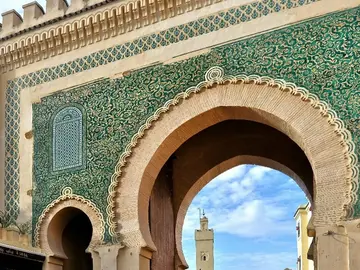
Fes el-Bali, the old walled medina, is one of the largest car-free urban areas anywhere, and GPS gives up quickly in its covered lanes. That is why a free walking tour of Fes is worth booking on your first morning rather than your last. Tours run for two and a half to four hours and meet just outside the walls: at Bab Boujloud, the tiled Blue Gate, by the Batha post office and hotel, at the car park near Bab el-Hadid, or at the northern gates of Bab Guissa and Bab Jdid.
The classic Fes walking tour runs downhill along Talaa Kebira, the medina's main spine. Guides stop at the Bou Inania Madrasa, the carved fountain and woodwork museum of Nejjarine Square, the shrine of Moulay Idriss II, the city's patron, and the outside of Al-Qarawiyyin, founded in the ninth century and often called the oldest university in the world. Then come the craft quarters: the coppersmiths hammering in Place Seffarine, the dyers' street and the Chouara tannery, seen from the terraces of the leather shops around it. Some routes cross the river to the Andalusian Mosque or call at the old Maristan, a medieval hospital known for treating patients with music.
The madrasas and museum charge a small entry fee, and guides will explain them from the door if you would rather not go in. Many tours include a stop at a herbalist, a weaving or argan cooperative or a tannery shop: you are welcome to look and never obliged to buy. English and Spanish are both well served, with French, Italian and Portuguese on some walks. For Marrakech, Chefchaouen and the north, see our Morocco page.
The routes Fes guides walk
Blue Gate to the tanneries
The standard three-hour introduction, starting at Bab Boujloud or Batha and following Talaa Kebira down into the heart of the medina.
- Bab Boujloud (Blue Gate)
- Bou Inania Madrasa
- Talaa Kebira
- Nejjarine Square and fountain
- Zaouia of Moulay Idriss II
- Al-Qarawiyyin
- Place Seffarine
- Chouara tannery
Craft quarters and the Andalusian side
A three-hour walk from Bab Jdid with a panoramic start, crossing the medina's eastern half and its working souks. It ends near a food market in time for lunch.
- Panoramic viewpoint over the medina
- Andalusian Mosque
- Chouara tannery
- Al-Qarawiyyin
- Funduq (caravan inn)
- Place Seffarine
- Dyers' souk
- Maristan Sidi Frej
Residential lanes and hidden Fes
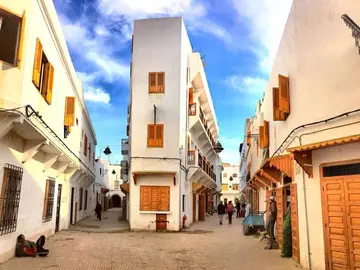
A three-hour walk from Batha that spends more time in the quiet residential lanes, explaining house design and street signs before reaching the souks.
- Residential lanes (derbs)
- Kissariat el-Kifah
- Attarine Madrasa
- Al-Qarawiyyin
- Zaouia of Moulay Idriss II
- Place Seffarine
- Dyers' square
- Chouara tannery
When to join a Fes walking tour
Spring and autumn are ideal. Inland Fes gets very hot from June to September, so take a morning tour; the covered souks stay cooler than the open squares. Winters are mild by day but damp, and the medina's stone lanes are slippery after rain.
The tanneries are most active in the morning, when the dye pits are freshly filled. Many shops close on Friday around midday prayers, and during Ramadan the medina is slow by day and lively after sunset.
Good to know
- Wear shoes with grip. The medina is steep, the cobbles are polished, and you walk downhill on the way in and uphill on the way out.
- When you hear 'balak!', step aside: it is a mule or a handcart coming through.
- Ignore young men who tell you a lane is closed or offer to lead you to the tannery; they expect payment or a shop commission.
- Non-Muslims cannot enter the shrine of Moulay Idriss II or Al-Qarawiyyin, but guides show you where to look through the doors.
- The tannery smell is strong. Shops often hand out a sprig of mint to hold under your nose.
- Carry small dirham notes for madrasa tickets, mint tea and the tip; cards are rarely accepted inside the walls.
Self-guided walking tour of Fes: Bab Boujloud to Chouara
About 2 km and two to three hours with stops, downhill through Fes el-Bali along Talaa Kebira. Return uphill via Talaa Sghira or take a taxi from Bab Rcif.
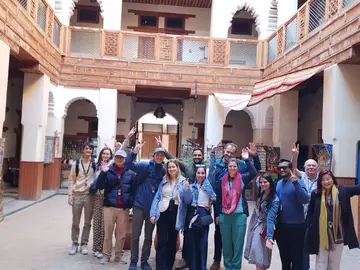
- Bab Boujloudstart at the Blue Gate, tiled blue outside and green inside.
- Bou Inania Madrasaa Marinid religious school with carved cedar, stucco and a minaret, open to visitors for a small fee.
- Dar al-Maganalook up opposite the madrasa at the remains of a medieval water clock.
- Talaa Kebirawalk the main street past bakeries, butchers and cobblers, following its gentle descent.
- Nejjarine Squarea tiled fountain and an old merchants' inn, now a museum of woodwork.
- Zaouia of Moulay Idriss IIpeek through the doorway of the shrine of the city's patron saint.
- Attarine Madrasaa small, exquisitely decorated madrasa beside the old spice market.
- Al-Qarawiyyinglimpse the courtyard of the ninth-century mosque and university from its gates.
- Place Seffarinethe coppersmiths' square, loud with hammering, with the old university library on one side.
- Chouara tanneryfollow the signs and the smell to the honeycomb of dye pits, best seen from a shop terrace.