Vigo for treasure hunters Free Walking Tour
📍 Starts: Praza Porta do Sol, 1 · Guide: FREE TOUR VIGO by Borja Concheiro
Book free spot Free · pay what you like
A hilly Atlantic port of oysters, legends and sea views. A few local guides lead tip-based walks, some in English.
Booking reserves your place; nothing is charged. Ratings and review counts from GuruWalk, updated 19 November 2026.
Vigo is Galicia's biggest city and one of the great fishing ports of Europe, stacked up a hillside above a long sea inlet with the Cíes Islands guarding the mouth. It's no museum piece, and that's why a guide helps. A free walking tour of Vigo explains the fishermen's lanes, the granite town houses of the boom years and the strange sculptures, starting with El Sireno, the fish-man on his columns in Porta do Sol.
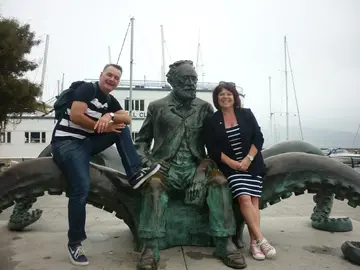
The route described in most detail climbs from the port. It starts at the Nadador statue, crosses to the Casco Vello by the A Laxe footbridge, and passes the A Pedra market, the oyster street and the co-cathedral of Santa María. Then come Praza da Constitución and Praza da Princesa, where the city remembers the Reconquista of 1809, when townspeople drove out Napoleon's troops. Beyond Porta do Sol, the walk takes an escalator up towards the San Sebastián fortress and ends at the Olivo viewpoint, named after the olive tree on the city's coat of arms.
Only a handful of tours run here. Two are listed in English and Spanish: a two-hour city walk and an evening round of myths, with witches, treasure ships and Captain Nemo, whom Jules Verne sent to Vigo Bay. The port-to-viewpoint walk and a seasonal Christmas-lights tour are in Spanish. Vigo pairs well with Santiago de Compostela or, over the Portuguese border, Porto; see all of Spain.
An hour and three quarters in Spanish with local historians, climbing from the Nadador statue to a view of the Cíes Islands.
Two hours in English or Spanish from El Sireno, mixing city history with food and local life. The listing doesn't name its other stops.
A 90-minute night walk in English or Spanish, also from El Sireno, on witches, sunken treasure and Celtic Galicia. It's told by theme rather than by named stop.
Vigo's weather comes off the Atlantic: mild all year, green for a reason, and liable to turn wet between October and April. Summer is warm rather than hot, so a walk works at any time of day. Late afternoon gives the best light over the bay, and sunset behind the Cíes is the local show.
The busiest season after summer is Christmas, when Vigo's street lights draw crowds from across Spain. A Spanish-language tour walks the illuminations then, through the Casco Vello and the Alameda; expect packed streets, especially at weekends. Cruise days fill the lanes by the port in the morning. The English-listed city walk only goes ahead with a confirmed booking made at least twelve hours in advance, so don't leave it to the day.
About 3 km and two hours, from the waterfront up through the old town to a viewpoint. The last leg to O Castro is steep and optional.