Free walking tours in Jodhpur

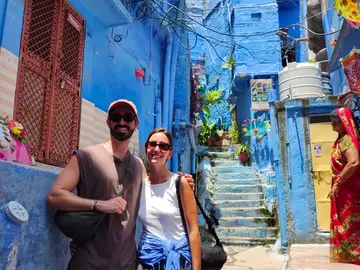
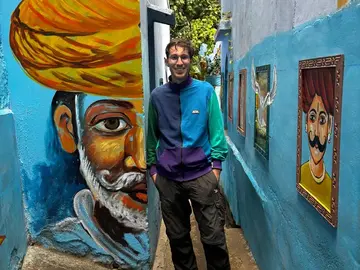
Indigo lanes climb from the Clock Tower bazaar towards Mehrangarh Fort, and a local guide knows which turnings lead somewhere.

  • 🚶 11 free tours
  • ★ 4.89 average
  • 💬 735 reviews
  • 🗣 English

Top free walking tours in Jodhpur

Booking reserves your place; nothing is charged. Ratings and review counts from GuruWalk, updated 19 November 2026.

What a Jodhpur Blue City walking tour covers

Jodhpur grew up beneath a single sandstone ridge. Rao Jodha laid the foundations of Mehrangarh Fort on it in 1459, and the old city spread out below in a tangle of lanes, many of them washed in shades of blue. Almost every Jodhpur walking tour begins at the Ghanta Ghar, the Clock Tower in the middle of Sardar Market, or a few minutes away at Toorji Ka Jhalra, the deep eighteenth-century stepwell that has become the old city's meeting place.

From there the classic Blue City walking tour heads uphill. Guides name Pachetia Hill, a rise in the middle of town with a wide view over the blue rooftops, and Navchokiya in Brahmpuri, one of the oldest quarters below the fort, along with the Ranisar and Padamsar lakes. Other walks stay in the market streets: spice and textile stalls, a Krishna temple, old havelis and sweet shops. You see the fort from below and from the rooftops; going inside is a separate visit with its own ticket. Walks run about two hours, a couple stretch to two and a half and one is a quick hour.

There are also two walks that put food first, with street snacks and a stop for lassi; on these you pay for what you eat. Every Jodhpur tour on the list runs in English, and at least one won't go ahead for a single booking. For more of Rajasthan, see Jaipur, or browse our India page.

The routes Jodhpur guides walk

Stepwell, Pachetia Hill and Brahmpuri

The most common loop, about two hours from the Clock Tower or the stepwell and back, with a short climb for the view. In English.

  1. Clock Tower
  2. Toorji Ka Jhalra stepwell
  3. Pachetia Hill
  4. Navchokiya
  5. Ranisar and Padamsar lakes
  6. Clock Tower Market

Markets and hidden blue lanes

Two hours from the stepwell, for people more curious about trade and daily life than viewpoints. In English.

  1. Clock Tower
  2. Spice market
  3. Textile market
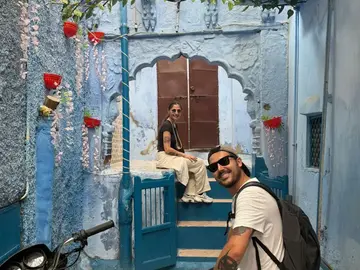
  4. Blue lanes of the old city
  5. Krishna temple
  6. Sweet shops
  7. Old havelis

Food and the Blue City

About two and a quarter hours from the stepwell, mixing the blue Brahmin houses with snacks and a lassi; you pay for the food.

  1. Clock Tower Market
  2. Blue-painted Brahmin houses
  3. Stepwell
  4. Street-food stop
  5. Krishna temple

When to walk in Jodhpur

Jodhpur sits on the edge of the Thar Desert, so October to March is the time to walk: clear, dry days and cool mornings, cold enough in December and January to want a jumper at dawn. From April to June the heat is fierce well before noon. The monsoon, roughly July to September, is short and patchy here but makes the lanes slippery when it comes.

Start early or late. In the first hours after sunrise the blue walls are in soft light, the stepwell is quiet and the fort glows above the rooftops. Late afternoon is the other good slot, when the markets are busy and the sandstone of Mehrangarh turns gold.

Good to know

  • The lanes towards the fort are steep, narrow and shared with motorbikes and cows; wear closed shoes with grip.
  • Carry water and a hat even in winter: there is little shade on Pachetia Hill or the climb to Brahmpuri.
  • Ask before you photograph people in their doorways; most homes in the blue lanes are lived in.
  • Shoes come off at temples, and shoulders and knees should be covered.
  • Politely ignore offers of rooftop views or spice-shop visits from people who join you uninvited.
  • If you're travelling alone, check the listing first, as one walk needs at least two people to run.

Self-guided Blue City walking tour of Jodhpur

About 4 km and three hours from the Clock Tower up to Mehrangarh Fort and on to Jaswant Thada. The climb is steady and steep in places, so start early.

  1. Ghanta Ghar (Clock Tower)the old city's landmark, built under Maharaja Sardar Singh and ringed by market stalls.
  2. Sardar Marketspices, textiles and bangles packed between the tower's gates.
  3. Toorji Ka Jhalraa deep, carved stepwell from the 1740s, now restored and cleared of rubble.
  4. Gulab Sagaran old reservoir a short walk away, with the city crowding its banks.
  5. Navchokiyafollow the lanes up into Brahmpuri, where the blue is densest.
  6. Fateh Polone of the fort's gateways, at the top of the old quarter.
  7. Mehrangarh Fortsheer walls on the rock; going inside is ticketed and takes a couple of hours.
  8. Jaswant Thadaa white marble cenotaph for Maharaja Jaswant Singh II, along the ridge from the fort.

Jodhpur free tours: questions people ask

Is there a free walking tour in Jodhpur?
Yes. Several tip-based guides lead walks in the Blue City most days, mainly from the Clock Tower or the Toorji Ka Jhalra stepwell. Booking is free and you tip what you think it was worth.
What does a Jodhpur Blue City walking tour include?
Usually the Clock Tower market, the stepwell, the blue lanes of Brahmpuri and a viewpoint such as Pachetia Hill. Mehrangarh is seen from outside; entry to the fort is not part of the walk.
Is there a Jodhpur food walking tour?
Yes, two walks focus on local snacks and sweets, such as mirchi vada and kachori. You pay for the food yourself on top of the tip.
Where do Jodhpur walking tours start?
At or near the Clock Tower in Sardar Market, or by Toorji Ka Jhalra, a few minutes' walk away. The listing tells you which.
Why are Jodhpur's houses blue?
Guides often link the colour to Brahmin households and to keeping homes cool, and you'll hear other theories too. No single explanation is settled, which makes it a good question to ask on the walk.
How much should I tip on a Jodhpur walking tour?
About ₹500–1,000 (US$6–11) per adult for two hours, in cash or by UPI, plus your own food on the food walks.

More free tours in India

All India cities →
Book a free tour in Jodhpur